Wellness is a modern word with ancient roots. As a modern concept, wellness has gained currency since the 1950s, 1960s and 1970s, when the writings and leadership of an informal network of physicians and thinkers in the United States largely shaped the way we conceptualize and talk about wellness today.
The origins of wellness, however, are far older—even ancient. Aspects of the wellness concept are firmly rooted in several intellectual, religious and medical movements in the United States and Europe in the 19th century. The tenets of wellness can also be traced to the ancient civilizations of Greece, Rome and Asia, whose historical traditions have indelibly influenced the modern wellness movement.
For more information: GWI’s foundational research on the history of wellness is contained in the 2010 report Spas and the Global Wellness Market: Synergies and Opportunities. For more details, download the Full Report. Join our global community to expand your knowledge and gain access to the latest wellness industry news, wellness evidence and research.
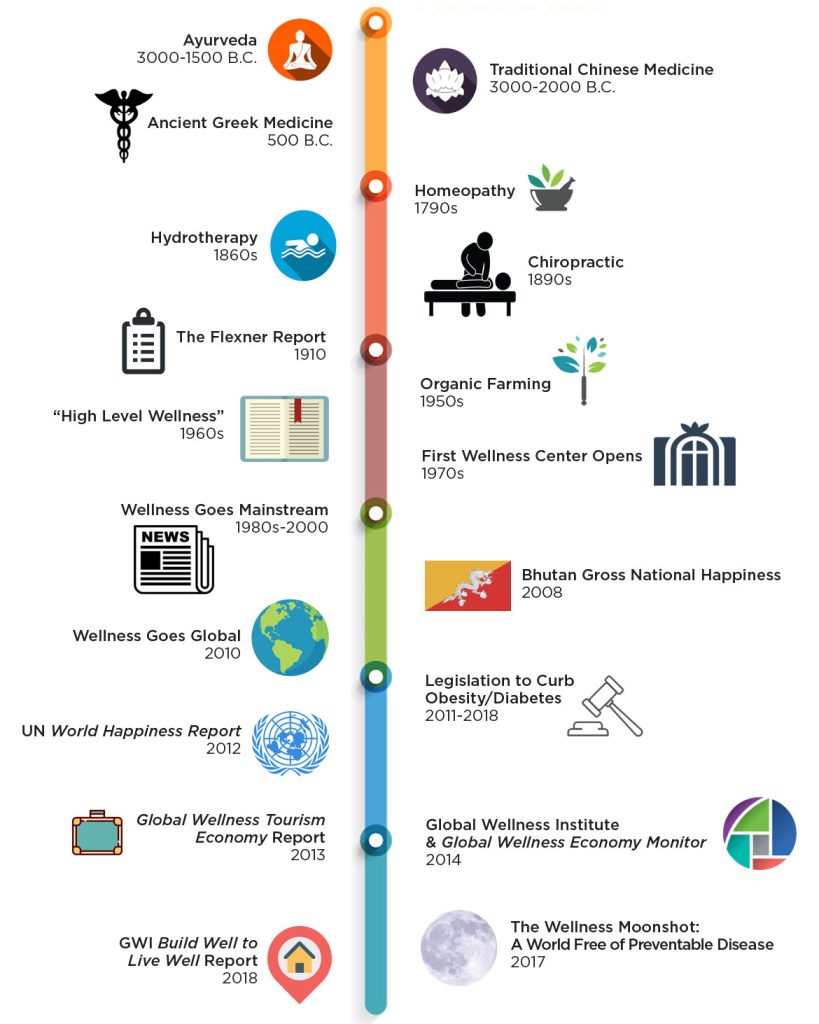
The Evolution of Wellness
Ancient Wellness
3,000-1,500 BC: Ayurveda – originated as an oral tradition, later recorded in the Vedas, four sacred Hindu texts. A holistic system that strives to create harmony between body, mind and spirit, Ayurvedic regimens are tailored to each person’s unique consitution (their nutritional, exercise, social interaction and hygiene needs) – with the goal of maintaining a balance that prevents illness. Yoga and meditation are critical to the tradition, and are, of course, increasingly practiced worldwide.
3,000 – 2,000 BC: Traditional Chinese Medicine (TCM), one of the world’s oldest systems of medicine, develops. Influenced by Taoism and Buddhism, TCM applies a holistic perspective to achieving health and wellbeing, by cultivating harmony in one’s life. Approaches that evolved out of TCM, such as acupuncture, herbal medicine, qi gong and tai chi, have become core, modern wellness – and even Western medical – approaches.
500 BC: Ancient Greek physician Hippocrates – is possibly the first physician to focus on preventing sickness instead of simply treating disease, and also argued that disease is a product of diet, lifestyle and environmental factors.
50 BC: Ancient Roman medicine emphasized disease prevention, adopting the Greek belief that illness was a product of diet and lifestyle. Ancient Rome’s highly developed public health system (with its extensive system of aqueducts, sewers and public baths) helped prevent the spreading of germs and maintained a healthier population.
19th Century Intellectual & Medical Movements
In the 19th century new intellectual movements, spiritual philosophies and medical practices proliferated in the United States and Europe. A number of alternative healthcare methods that focus on self-healing, holistic approaches, and preventive care – including homeopathy, osteopathy, chiropractic, and naturopathy – were founded during this era and gained widespread popularity in both Europe and the United States. Other new philosophies were more spiritually oriented (such as the “mind-cure movements,” including New Thought and Christian Science) and were instrumental in propagating the modern idea that a primary source of physical health is one’s mental and spiritual state of being.
While some of the beliefs espoused by the thinkers behind these movements have been discredited, or seem “wacky” today, these movements did popularize ideas about regaining or maintaining one’s health through diet, exercise and other lifestyle measures. The philosophies embodied in these 19th century systems – that a healthy body is a product of a healthy mind and spirit – are now considered precursors to the current, thriving wellness and self-help movements. In addition, although these approaches fell out of favor with the rise of modern, evidence-based medicine in the mid-20th century, several of them are now regaining favor within the mainstream medical community and the general public.
1650s: The use of the word “wellness” in the English language – meaning the opposite of “illness” or the “state of being well or in good health” – dates to the 1650s, according to the Oxford English Dictionary. The earliest published reference is from the 1654 diary entry of Sir Archibald Johnston: “I … blessed God … for my daughter’s wealnesse.” The first citation with modern spelling is from a 1655 letter from Dorothy Osborne to her husband, Sir William Temple: “You … never send me any of the new phrases of the town… Pray what is meant by wellness and unwellness?”
1790s: German physician Christian Hahneman develops Homeopathy, a system that uses natural substances to promote the body’s self-healing response.
1860s: German priest Sebastian Kneipp promotes his “Kneipp Cure”, combining hydrotherapy with herbalism, exercise and nutrition. The New Thought movement also emerges, around Phineas Quimby’s theories of mentally-aided healing.
1870s: Mary Baker Eddy founds spiritual-healing-based Christian Science. Andrew Taylor Still develops Osteopathy, a holistic approach grounded in manipulating muscles and joints.
1880s: Swiss physician Maximilian Bircher-Benner pioneers nutritional research, advocating a balanced diet of fruits and vegetables. The YMCA launches as one of the world’s first wellness organizations, with its principle of developing mind, body and spirit.
1890s: Daniel David Palmer develops Chiropractic, focused on the body’s structure and functioning.
1900s: John Harvey Kellogg (director of the Battle Creek, Michigan Sanitorium) espouses a healthy diet, exercise, fresh air, hydotherapy and “learning to stay well.” Naturopathy, focused on the body’s ability to heal itself through dietary and lifestyle change, herbs, massage and joint manipulation, also spreads to the U.S. from Europe. Austrian philosopher Rudolf Steiner develops the spiritual movement of anthrosophy and the holistic system of anthrosophical medicine. Another Austrian, F.X. Mayr, develops “Mayr Therapy”, a detoxification and dietary modification program.
1910: The Carnegie Foundation’s Flexner Report, a critique of North America’s medical education system for lack of standards and scientific rigor, questions the validity of all forms of medicine other than biomedicine, resulting in most alternative systems (homeopathy, naturopathy, etc.) being dropped from mainstream medical education, and setting the stage for our modern disease-oriented, evidence-based medicine.
20th Century: Wellness Spreads and Get Serious
Our modern use of the word “wellness” dates to the 1950s and a seminal – but little known – work by physician Halbert L. Dunn, called High-Level Wellness (published1961). Although Dunn’s work received little attention initially, his ideas were later embraced in the 1970s by an informal network of individuals in the U.S., including Dr. John Travis, Don Ardell, Dr. Bill Hettler, and others. These “fathers of the wellness movement” created their own comprehensive models of wellness, developed new wellness assessment tools, and wrote and spoke actively on the concept. Travis, Ardell, Hettler and their associates were responsible for creating the world’s first wellness center, developing the first university campus wellness center, and establishing the National Wellness Institute and National Wellness Conference in the U.S.
From 1980-2000, the wellness movement begins to gain momentum, and get taken more seriously by the medical, academic and corporate worlds. For instance, Hettler’s National Wellness Institute caught the attention of Tom Dickey and Rodney Friedman, who then established the monthly Berkeley Wellness Letter (1984), designed to compete with the Harvard Medical School Health Letter, pointedly using “wellness” in the title as contrast. This influential academic publication presented evidence-based articles on wellness approaches, while also debunking numerous health fads. More medical establishment validation: in 1991 the U.S. National Center for Complementary and Alternative Medicine (NCCAM) was established, as part of the government-funded National Institutes of Health.
More government-sponsored programs to promote healthier lifestyles launched in U.S. cities/states. The modern concept of wellness also spread to Europe, where the German Wellness Association (Deutscher Wellness Verband, DWV) and the European Wellness Union (Europäischen Wellness Union, EWU) were founded in 1990.
At the latter end of the 20th century, many corporations began developing workplace wellness programs. The fitness and spa industries globally experienced rapid growth. And an ever-growing line-up of celebrities and self-help experts started bringing wellness concepts to a mainstream audience. However, despite all these disparate developments, this momentum had not yet coalesced under the formal banner of a “wellness industry.”
 FREE SHIPPING FOR ALL ORDERS OF ₹999








 Best in Quality